
In April 1854, a book appeared at Paternoster Row, near St Paul’s Cathedral, a hub of the book trade in the City of London. It contained a nine-page section on “The Arian settlers and Aboriginal races of India” that claimed Sanskrit had been introduced in India by conquerors in some very remote age. No aspect of India’s history that would be written since has been untouched by the years of colonial discourse that followed. On the 169th anniversary of this fateful moment, it is finally time to tell this arc of India’s history truthfully.
THE 1854 PROJECT
The 1854 Project is an ongoing initiative from the Institute for ReWriting World History that began in April 2023, the 169th anniversary of the publication of Outlines of the Philosophy of Universal History, Applied to Language and Religion. It aims to reframe India’s history by placing the consequences of colonialism and the contributions of Indians at the very center of India’s many narratives.1
1854 and World History | The 1854 Project Book
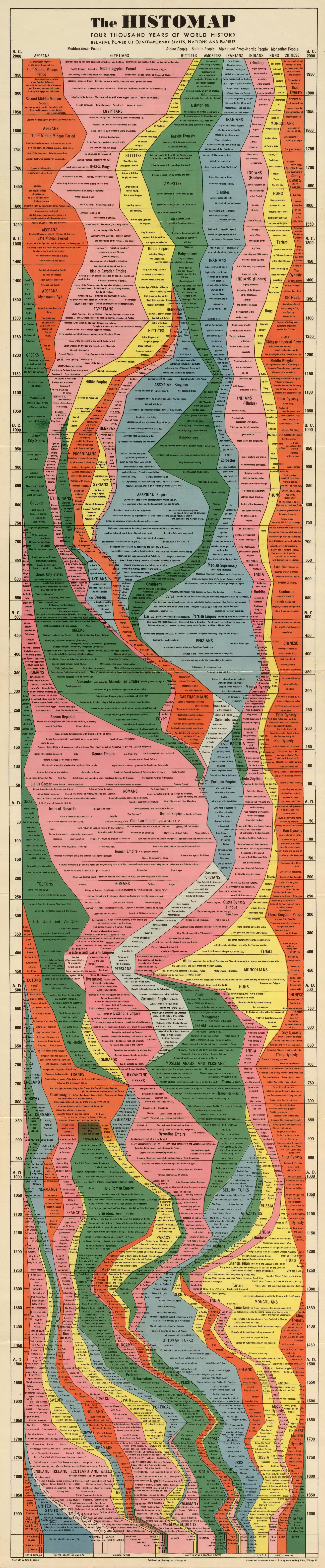
Image from The Histomap (1931), Prose from The 1619 Project (2019)

The 1854 Project and the Long Battle Over World History
Fights over how we tell the ancient past go back more than a century — and have a great deal to teach us about our current divisions.
Illustration: The Frontispiece of Leviathan by Abraham Bosse

In order to understand the coloniality of modern scholarship on India, you have to start with the mythology of the West.
Illustration: “India House. Sale Room.” by Thomas Rowlandson et al.

Stereotypes about Indian society were used to justify colonialism — and are still believed by historians today.
Photograph: Statue of Sir W. Cavendish Bentinck, Calcutta

For more than a hundred years, Indians were recruited as indentured servants to work in overseas colonies. Today most of the sites of this trade are forgotten.
Manuscript: A page in an indentured labourer contract, CO 111/161

Indology holds onto an unscholarly assumption from its founding: that some people deserve more power than others.
Illustration: “The University Printing House, Oxford“ by J.H. Parker

Indians have always possessed historical consciousness. No wonder colonial scholars covered up this past.
Illustration: The City of Delhi Before the Siege, The London Illustrated News

What does the explosion of caste in India have to do with colonialism? Quiet a lot.
Manuscript: A page from Seventy-two Specimens of Castes in India by T. Vardapillay

Consequential moments in the Indian Independence Movement
Exhibit: Information Revolution Gallery – National Science Centre

Why was India partitioned? The answer begins with policies enacted after the ‘Sepoy Mutiny.’
Illustration: Map of Province of East Bengal and Assam

Colonialism fanned the flames of communal divisions and sectarian violence. Both still shape India’s political discourse.
Illustration: Frontcover of Tamas by Bhisham Sahni.

The sugar that fueled colonialism and slavery has a longer history that begins in India.
Illustration: View of Calechut from Sciographia Cosmica by Daniel Meissner

A vast wealth gap, underwritten by the ‘rules-based order,’ separates the third World and the first World.
Photograph: 1949 Press Photo Britain’s devaluation of the pound sterling

Their ancestors fought for self-rule. On January 26, 1950 they became the authors of the Republic of India.
Photograph: Member of the constituent assembly of India

One hundred and sixty-nine years after colonial scholars first started rewriting India’s history, most Indians still don’t know the full story of colonialism.
Illustration: “Types de nez, de profil” from Éléments d’anthropologie générale

‘We are committing education malparctice’: Why Colonialism is mistaught — and worse — in schools and colleges.
Painting: “Christ Church Cathedral Oxford“ by Richard Gilson Reeve

A rewriting of world history is necessary.
Illustration: General sketch of the physical and geological features of British India

The Vedic context of religions of man
Painting: Mahadevi, the Great Goddess
FOOTNOTES
- Regional designations such as India, Tartary, Arabia, and Persia recurred on European maps for centuries, but their geographical dimensions varied tremendously from author to author and from generation to generation. The career of the term India exemplifies this fluidity. As the ultimate Orient of classical European geography, “India” expanded with each new discovery throughout the Renaissance, until it encompassed, in some usages, the majority of the globe. Ortelius’s 1570 map of India, for example, included all of modern-day South, East, and Southeast Asia. In other cartographic representations, the Americas and even modern-day Ethiopia were placed within India’s bounds. Beginning in the 1700s, by contrast, the secular trend was one of gradual reduction, as India was limited first to South and Southeast Asia, and then, following the contours of British dominion, to South Asia alone. Its contraction would continue in the twentieth century, when India came to refer to a single South Asian state (Lewis and Wigen 161). ↩︎
BIBLIOGRAPHY
- Azad, Maulana Abul Kalam. Foreword. Eighteen Fifty-Seven, by Surendra Nath Sen, Publications Division, Ministry of Information & Broadcasting, Government of India, 1957, pp. v-xxi.
- Baldwin, James and William F Buckley, participants. “The American Dream and the American Negro.“ The Cambridge Union Society, 18 February 1965. BBC.
- Burke, Edmund. “Speeches in the Impeachment of Warren Hastings, Esquire, Late Governor-General of Bengal.“ The Works of the Right Honourable Edmund Burke, vol. 9. John C. Nimmo, 1887, pp. 327-493.
- Carr, Edward Hallett. “The Historian and His Facts.“ What is History?. Knopf, 1961, pp. 3-36.
- Chakrabarti, Dilip K.. ”The Interplay of Race, Language, and Culture.“Colonial Indology: Sociopolitics of the Ancient Indian Past. Munshiram Manoharlal Publishers Pvt. Limited, 1997, pp. 54-151.
- Chand, Tara. Preface. History of Freedom Movement in India, vol 1, Publications Division Ministry of Information & Broadcasting, 1961, pp. xi-xiii.
- Chatterjee, Partha. “The Cunning of Reason.“ Nationalist Thought and the Colonial World: A Derivative Discourse, University of Minnesota Press, 1986, pp. 167-170.
- Chaudhuri, Sashi Bhusan. “Historical Background.“ Civil Rebellion in the Indian Mutinies, 1857-1859, World Press, 1957, pp. 1-60.
- Clausewitz, Carl von. “What is War?” On War, translated by James John Graham. N. Trb̈ner & Co., 1873, pp. 1-13.
- Clive, Robert. “Disorders in Bengal.“ The Life of Robert, Lord Clive, vol 2, edited by John Malcolm. J. Murray, 1836, pp. 261-316.
- Das, Sisir Kumar. “Political Movements and Indian Writers.“ A History of Indian Literature: 1911-1956, struggle for freedom : triumph and tragedy. Sahitya Akademi, 1995.
- Digby, William. “Proem.” ‘Prosperous’ British India, T. Fisher Unwin, 1901, pp. 3-22.
- Dirks, Nicholas. “Introduction: The Modernity of Caste.“ Castes of Mind, Princeton University Press, 2011, pp. 3-17.
- Dodwell, H. H. “The Development of Sovereignty in British India.“ The Cambridge History of India: British India, 1497-1858, vol. 5, Cambridge University Press, 1962, pp. 589-608.
- Du Bois, W. E. B.. “Of Our Spiritual Strivings.“ The souls of black folk, essays and sketches, A. C. McClurg & co, 1903, pp. 1-12.
- Dumont, Louis. “History of Ideas.“ Homo Hierarchicus: The Caste System and Its Implications, translated by Mark Sainsbury, University of Chicago Press, 1970, pp. 21-32.
- Durant, Will. “For India.“ The Case for India, Simon and Schuster, 1930, pp. 1-56.
- Elst, Koenraad. “The Incurable Hindu Fondness for Pn Oak.“ Blogger, 2010, archive.org. Accessed 25 March 2012.
- Fanon, Frantz. ”On Violence.” The Wretched of the Earth. Translated by Constance Farrington. Grove Press, 1963, pp. 35-106.
- Firminger, Walter K. “The Grant Of The Diwani Of Bengal, Bihar And Orissa, 1765.“ Bengal, Past & Present: Journal of the Calcutta Historical Society, Calcutta Historical Society, 1914, pp. 11-26.
- Forrest, George. “1765-7: Governor of Bengal.” The Life of Lord Clive, vol. 2, Cassell and Company, 1918, pp. 294-342.
- Foucault, Michel. “Truth and Power.” Power/knowledge : selected interviews and other writings, 1972-1977, edited by Colin Gordon, Pantheon Books, 1980, pp. 109-133.
- Freud, Sigmund. “Humor.“ The Standard Edition of the Complete Psychological Works of Sigmund Freud, translated by James Strachey, vol. 21, Hogarth Press and the Institute of Psycho-analysis, 1961, pp. 160-66.
- Gandhi, Mahatma. “Discussion With Woodrow Wyatt.“ The Collected Works of Mahatma Gandhi. Volume 83, The Publications Division, 1981, pp. 404-406.
- Guénon, René. “Preface.“ The Crisis of the Modern World, translated by Marco Pallis et al.,Sophia Perennis, 2001, pp. 1-6.
- Hannah-Jones, Nikole. “The 1619 Project.“ New York Times magazine, 2019.
- Harvey, David. “The spatial fix–Hegel, von Thunen, and Marx.” Antipode 13.3 (1981): 1-12.
- Havell, Ernest Binfield. “Introduction.” The history of Aryan rule in India from the earliest times to the death of Akbar, Fredrik. A. Stokes Company, 1918, pp. v-xvi.
- Hegel, Georg Wilhelm Friedrich. “Introduction.“ The Philosophy of History, translated by John Sibree, Henry G. Bohn, 1861, pp. 1-82.
- Hobbes, Thomas. “Of the First and Second Naturall Lawes, and of Contracts.“Leviathan, or, the Matter, Forme and Power of a Common-Wealth, Ecclesiasticall and Civill, Andrew Crooke, at the Green Dragon in St. Pauls Church-yard, 1651, pp. 96-107.
- Inden, Ronald B. Imagining India. Blackwell, 1990, pp.7-43.
- Jinnah, Muhammad Ali. “Address of the Founder of Pakistan Quaid-E-Azam Muhammad Ali Jinnah on 11th August, 1947 to 1st Constituent Assembly.“ Speeches, Statements & Messages of the Quaid-e-Azam: 1946-1948, edited by Khurshid Ahmed Khan Yusufi. Bazm-e-Iqbal, 1996, pp. 2601-2602.
- Johnson, W. J.. “caste.“ A Dictionary of Hinduism. OUP Oxford, 2009, p. 80-81.
- Kaye, John William. “Preface.“ A History of the Sepoy War in India, 1857-1858, vol 1, W.H. Allen, 1870, pp. xii-xiv.
- Kerr, Robert. “History of the Discovery and Conquest of India by the Porugues, between the Years 1497 and 1505: From the Original Portuguese of Herman Lopes De Castaneda.“ A General History and Collection of Voyages and Travels, vol. 2, William Blackwood, J. Murray, J. Cuming, 1811, pp. 292-504.
- Lacan, Jacques. “The Function and Field of Speech and Language in Psychoanalysis.“ Ecrits: A Selection, translated by Alan Sheridan. Routledge, 2001, pp. 33-125.
- Lewis, Martin W. and Kären Wigen. “World Regions: An Alternative Scheme.“ The Myth of Continents: A Critique of Metageography, University of California Press, 1997, pp. 157-88.
- Locke, John. “Of Slavery.“ Two Treatises of Government, 1689, pp. 205-07.
- Löwith, Karl. “Introduction.“ Meaning in History: The Theological Implications of the Philosophy of History. University of Chicago Press, 1949, pp. 1-19.
- Majumdar, Ramesh Chandra. “Introduction.“ The Sepoy Mutiny and the Revolt of 1857, 1963, pp. xi-xii.
- Mayo, Ketherine. “Less Than Men.“ Mother India, Harcourt, Brace, And Company, Inc., 1927, pp. 150-163.
- Mills, James. “From The Establishment, On Legislative Authority, Of One Exclusive Companay, In The Year 1708, Till The Change In The Constitution Op The Company, By The Act Of 13th Geo. III. In 1773.” The History of British India, vol iii, James Madden, 1840, pp. 85-152.
- Muir, J. “Art. IX–On the Interpretation of the Veda.” The Journal of the Royal Asiatic Society of Great Britain and Ireland, vol. 2, 1835, pp. 303-402.
- Mukherjee, Mithi. “Justice, War, and the Imperium: India and Britain in Edmund Burke’s Prosecutorial Speeches in the Impeachment Trial of Warren Hastings.“ Law and History Review, vol. 23, no. 3, 2005, pp. 589-630.
- Müller, Friedrich Max. “The Arian Settlers and Aboriginal Races of India.” Outlines of the Philosophy of Universal History Applied to Language and Religion, edited by Christian Karl Josias Freiherr von Bunsen, Longman, Brown, Green, and Longmans, 1854, pp. 340-348.
- Müller, Friedrich Max. “Letter to the Duke of Argyll [Secretary of State for India].“ The Life and Letters of the Right Honourable Friedrich Max Müller, vol. 1, edited by Georgina Adelaide Müller, Longmans, Green And Company, 1902, pp. 357-358.
- Mun, Thomas. “The Exportation of Our Moneys in Trade of Merchandize Is a Means to Encrease Our Treasure.“ England’s Treasure by Forraign Trade, Thomas Clark, 1664, pp. 9-18.
- Naoroji, Dadabhai. “Poverty of India.” Poverty and Un-British Rule in India, Publications Division, Ministry of Information and Broadcasting, Govt. of India, 1901, pp. 1-125.
- Nehru, Jawaharlal. “Tryst with Destiny.“ Jawaharlal Nehrus Speeches, vol 1, Publications Division Ministry of Information and Broadcasting, 1949, pp. 25-26.
- Ortiz, Fernando. “On the Social Phenomenon of “Transculturation“ and Its Importance in Cuba.“ Cuban Counterpoint, Tobacco and Sugar, Duke University Press, 1995, pp. 97-103.
- PhiLiP. Gama route 1. 18 Sept. 2008. Wikimedia Commons.
- Polanyi, Karl. “Rise and Fall of Market Economy.” The Great Transformation. Farrar & Rinehart, 1944, pp. 151-162.
- Quijano, Anibal. “Coloniality of Power and Eurocentrism in Latin America.“ International sociology, vol. 15 no. 2, 2000, pp. 215-32.
- Risley, Sir Herbert Hope. “The Physical Types.“ The People of India, Thacker, Spink And Company, 1915, pp. 1-61.
- Roth, Catharine. “Know Thyself.” Suda On Line: Byzantine Lexicography, edited by David Whitehead, University of Kentucky, 2002, archive.org. Accessed 17 September 2019.
- Roy, Manabendra Nath. “Rise of the Bourgeoisie.“ India in Transition, J.B. Target, 1922, pp. 17-41.
- Said, Edward. “Introduction.“ Orientalism, Pantheon Books, 1979, pp. 1-29.
- Sanil, Sharan. “The Outrageous Life of P.N. Oak: The Teacher, Soldier, and Conspiracy Theorist Behind the Taj Mahal Row.“ MW.Com India, 2022, archive.org. Accessed 13 May 2022.
- Sir William Jones. “485. To the First Marquis of Cornwallis.“ The Letters of Sir William Jones, vol. 2. Clarendon Press, 1970, pp. 794-800.
- Sparks, John B. “The Histomap, Four Thousand Years of World History; Relative Power of Contemporary States, Nations, and Empires.“ Print, Rand McNally & Co., 1931.
- Sapir, Edward. “Communication.“ Encyclopedia Of The Social Sciences, edited by Edwin R.A. Seligman, volume 3, The MacMillian Company, 1923, pp. 78-81.
- Sridharan, Kripa. “Grasping the Nettle: Indian Nationalism and Globalization.“ Nationalism and Globalization : East and West, edited by Leo Suryadinata. ISEAS, 2000, pp. 294-318.
- Sullivan, John. Are we bound by our Treaties? A plea for the Princes of India. Effingham Wilson, 1853.
- Terrace, Carlton. Preface. Outlines of the Philosophy of Universal History Applied to Language and Religion, edited by Christian Karl Josias Freiherr von Bunsen, Longman, Brown, Green, and Longmans, 1854, pp. A3-A6.
- Tilak, Shrinivas. “P.N.Oak: The Lone Fighter, Etymologist, and Historian.“ Blogspot, 2008, archive.org. Accessed 22 January 2024.
- Trautmann, Thomas R. “The Racial Theory of Indian Civilization.“ Aryans and British India, Yoda Press, 2005.
- Travers, Robert. “A British Empire by Treaty in Eighteenth-Century India.“ Empire by Treaty: Negotiating European Expansion, 1600-1900, Oxford University Press, 2014, pp. 132-60.
- Trentmann, Frank. “Imperium of Things.” Empire of Things: How We Became a World of Consumers, from the Fifteenth Century to the Twenty-First, Penguin Books, 2017, pp. 119-173.
- Weber, Max. “India and Hinduism.“ The Religion of India : The Sociology of Hinduism and Buddhism. Translated by Hans Gerth and Don Martindale, Free Press, 1958, pp. 3-54.
- Report from the Select Committee of the House of Lords Appointed to Consider of the Petition of the East India Company for Relief. “Minutes of Evidence To The Petition of the East India Company for Relief.“ House of Lords, 1840, pp. 3-160.
- The Fifth Report from the Select Committee on the Affairs of the East India Company, “Appendix, No. 31.“ House of Commons, Select Committee on the East India Company, 1812, pp. 908-1008.
- The Sessional Papers Printed By Order of The House of Lords, or Presented by Royal Command, In The Session 1852-3. “Copies Of Any Correspondence Between The Government Of India And The Court Of Directors, And Of Any Documents Received From India, Relative To The Lines To Be Selected For The System Of Railway Communication In That Country.” vxiii, House of Lords, 1854, pp. 267-434.

For students
Looking for ways to learn more? You can find resources at Indian Council of Historical Research. And it’s available to every one!
Legal Notice:
This work is not endorsed by or affiliated with any parties connected with the original.